
Long-haul travel becomes a very different experience once you stop thinking about it as simply “getting through a flight.”
Over time, I realised that the travellers who always seemed calm, comfortable, and organised usually weren’t relying on luck. They’d gradually built systems around how they travelled.
Since around 2014, I’ve flown long-haul regularly and experimented with a huge range of travel products, comfort items, bags, and organisational setups along the way.
Some things helped. Many didn’t.
But after years of trial and error, I eventually settled into a setup that worked so well I’ve barely changed most of it in the past five years.
In many ways, I realised I was essentially trying to recreate some of the comfort and flexibility associated with business class — while still flying economy.
Not luxury.
Not excess.
Just a smoother, calmer, more comfortable long-haul travel experience.
Over time, that gradually evolved into what I sometimes think of as my “Every Flight Pack” — not a single bag or product, but a travel system designed to improve comfort, organisation, accessibility, sleep, flexibility, and adaptability throughout the journey.
Because for me, the setup isn’t just about the aircraft seat itself.
It’s also about airport waits, overnight delays, cold terminals, long layovers, temporary luggage issues, and reducing unnecessary stress and friction while travelling.
One of the biggest changes this setup created wasn’t just physical comfort — it was psychological.
Long-haul travel used to feel much more reactive. Constantly adjusting, repositioning, waiting, dealing with discomfort, noise, poor sleep, or feeling slightly drained throughout the journey.
Now, the experience feels far calmer and more controlled overall.
Whether I’m sitting in a noisy terminal, waiting through a delay, resting during a layover, or flying overnight in economy, the setup allows me to settle into a comfortable environment almost anywhere rather than feeling dictated by the surroundings around me.
Oddly enough, once enough small friction points disappear, long-haul travel stops feeling like something to endure and starts feeling much easier to simply move through comfortably.
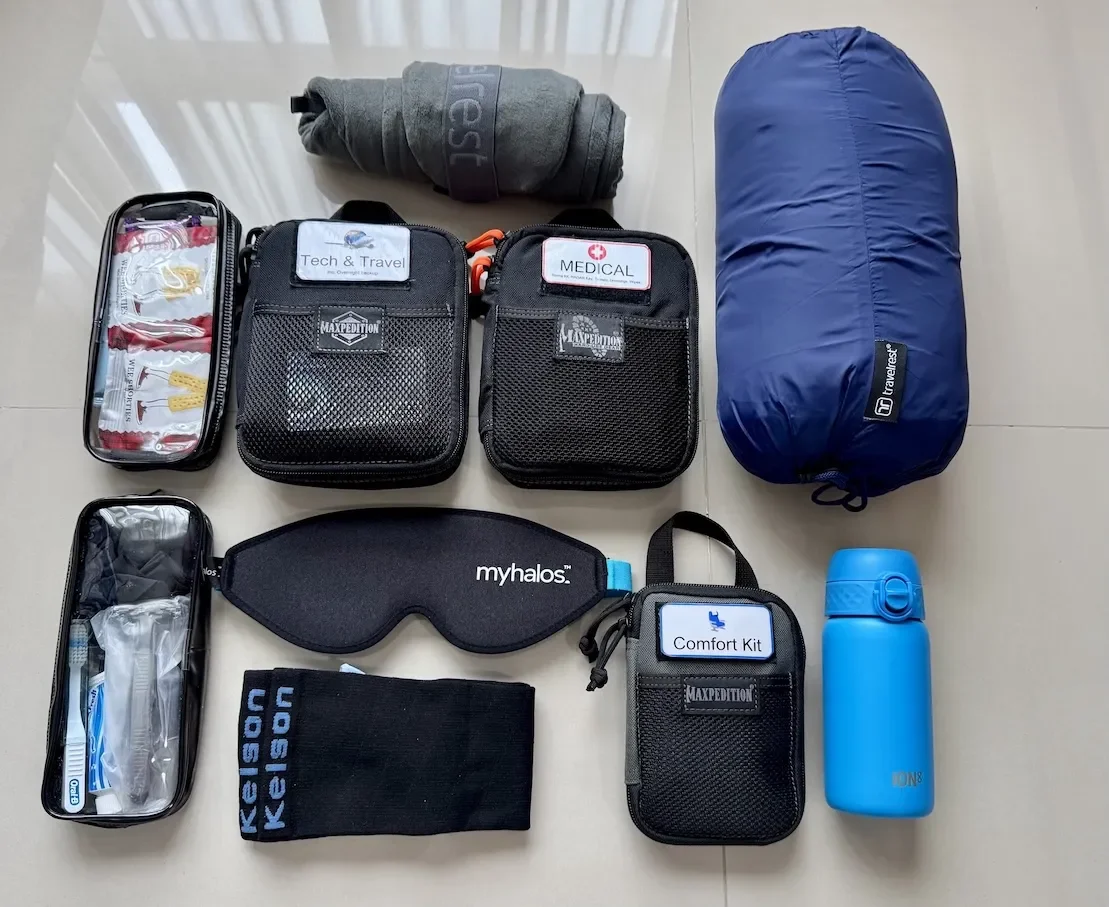
Underseat Bag Contents
Travelrest Wrap Travel Blanket
Compression Socks
Medical & Tech Pouches
Snack Kit
Emergency Overnight Kit
Comfort Pouch
Flask
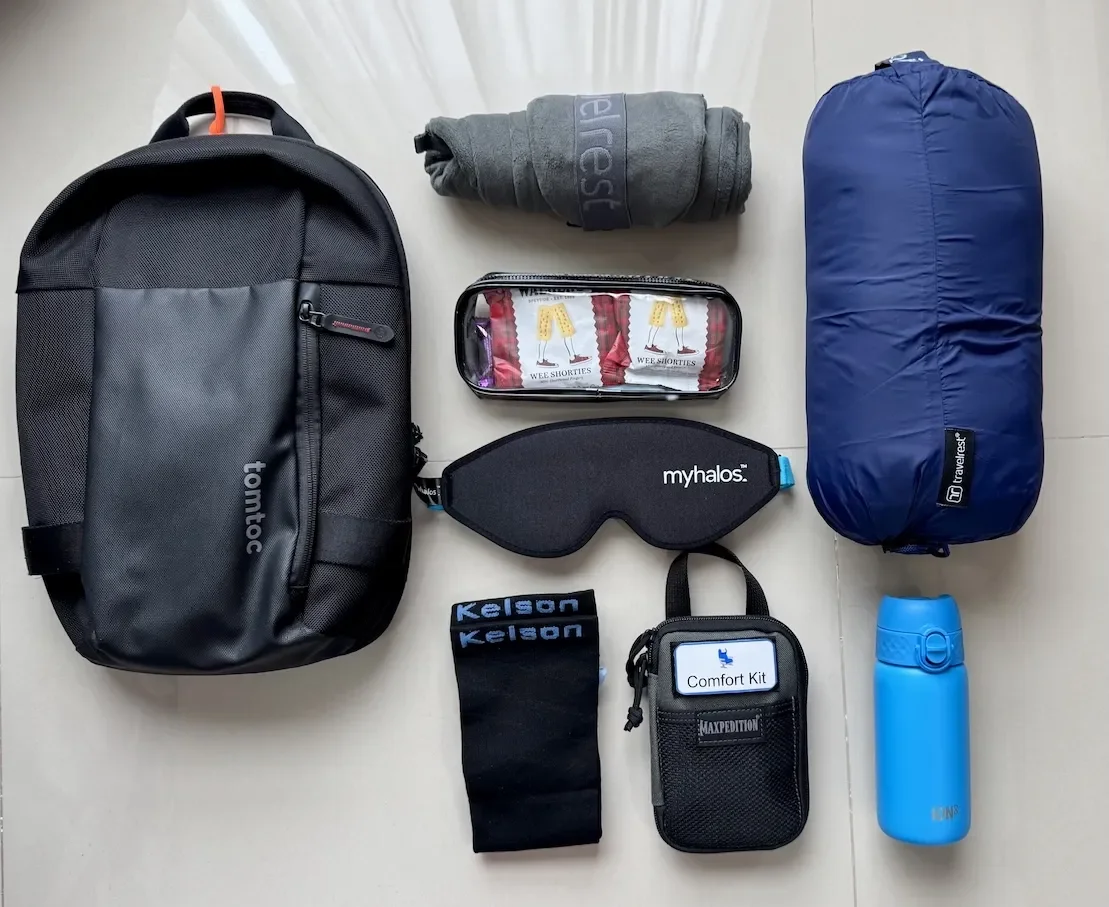
I normally carry on a single underseat bag containing a smaller pre-packed in-seat sling. Once onboard, I simply remove the sling before storing the larger bag overhead (when overhead space is available).
This keeps the items I use most during the flight — such as comfort items, snacks, hydration, and sleep essentials — immediately accessible without repeatedly accessing the overhead locker during the journey.
Why a Good Long-Haul Setup Matters
Most people think of long-haul discomfort as something unavoidable.
Economy class is cramped. Airports are cold. Flights are noisy. Sleep is inconsistent.
And to some extent, all of that is true.
But I’ve found there’s a huge difference between travelling unprepared and travelling with a setup intentionally designed around comfort and accessibility.
Small improvements compound surprisingly quickly over a 10–15 hour journey.
Reliable warmth, easy access to important items, good noise control, organised charging, and a stable sleep setup can completely change how manageable long-haul travel feels.
Oddly enough, some of the biggest improvements often come from solving problems that initially seem minor.
Reducing unnecessary movement.
Keeping important items within reach.
Being able to settle quickly into a comfortable position.
Individually, those things don’t sound especially dramatic.
Together, they make a surprisingly large difference.
For me, the biggest improvement wasn’t any single product.
It was creating a system where everything worked together with as little friction as possible.
My Core Long-Haul Setup Philosophy
The core idea behind my setup is actually very simple:
Reduce unnecessary friction wherever possible.
That means keeping things organised, accessible, reliable, and easy to move with.
Over time, I realised that discomfort during travel often comes from small repeated frustrations:
digging through bags
losing chargers
standing in aisles unnecessarily
searching for essentials
struggling to sleep
being too cold
constantly repositioning items
So now, almost everything I carry has a specific purpose.
I also try to avoid depending entirely on checked luggage for anything essential. Part of my setup is designed around maintaining a reasonable level of comfort and functionality even if luggage is temporarily delayed or unavailable.
I strongly prefer setups that keep both hands free while moving through airports or transitioning between locations. That flexibility becomes especially valuable during gate changes, long airport walks, delayed flights, or overnight disruptions.
Oddly enough, some of the biggest stress reductions in travel come from solving very small annoyances before they happen.
For me, the goal isn’t perfection.
It’s simply making long-haul travel feel calmer and easier to manage.
Sleep and Comfort Essentials
Sleep is probably the single biggest factor affecting how manageable long-haul travel feels.
If you sleep badly, everything else tends to feel worse — fatigue, stiffness, stress, patience, jet lag, and overall comfort all become noticeably harder to manage.
Over the years, I gradually refined a setup focused on creating a more stable sleep environment in economy class.
For me, the biggest improvements came from combining several smaller changes together: reliable warmth, noise reduction, light reduction, better seat positioning, easier access to essentials, and a supportive travel pillow that actually stabilises the upper body rather than just the neck.
Once those elements started working together properly, long-haul flights became dramatically more manageable.
I now regularly sleep well in economy class — something that once felt almost impossible.
One thing I also realised fairly early on is that sleeping position matters just as much as the products themselves.
For example, if you naturally sleep more comfortably on one side than the other, choosing the appropriate window seat can make a surprisingly large difference during overnight flights.
Likewise, supportive travel pillows that stabilise the upper body — not just the neck — can dramatically improve comfort, especially in aisle seats where drifting sideways becomes more likely.
I cover this in more detail in my guide to choosing the best plane seats and sleep positions for long-haul flights.
Interestingly, the same overall setup also works surprisingly well in airports during long layovers, overnight waits, delayed flights, and heavily air-conditioned terminals.
Over time, I’ve also learned where the quieter areas of many airports tend to be, which makes resting during long travel days significantly easier.
Adapting to Destination Time Zones
One thing that has made a surprisingly large difference to my long-haul travel experience is gradually shifting onto the destination time zone before departure whenever possible.
Even moving across a few hours in advance can help reduce the feeling of complete disorientation after landing.
Over time, I realised that many of the comfort systems I already relied on during travel — things like a blackout eye mask, supportive pillow, reliable warmth, noise-cancelling headphones, and a stable sleep setup — also made it much easier to maintain a destination-focused sleep schedule regardless of location.
Whether I’m on the aircraft itself, waiting in an airport, or dealing with a delay, the overall setup makes it far easier to rest properly when needed rather than simply sleeping whenever exhaustion takes over.
I’ve found this significantly reduces the amount of downtime I usually need after arriving, especially on longer trips where adjusting quickly makes a big difference.
Oddly enough, once you start treating long-haul travel as an environment you can actively manage — rather than simply endure — jet lag becomes much easier to minimise overall.
I’ll likely cover my full destination time-zone adjustment approach separately, as it has significantly improved how quickly I adapt after landing.
Noise Management and Reducing Fatigue
One change that significantly improved my long-haul travel experience was properly controlling noise.
Good noise-cancelling headphones don’t just reduce sound.
They reduce fatigue.
The constant background hum of an aircraft cabin may not always feel consciously loud, but over many hours it becomes mentally tiring.
Once I started consistently travelling with good noise-cancelling headphones, I noticed several improvements almost immediately:
better sleep
lower stress
improved focus
reduced fatigue after landing
more flexibility with seat choice
Oddly, once noise becomes less of a problem, certain seats and airport environments suddenly become much more manageable.
One unexpected benefit of gradually refining my long-haul travel setup is that it allows me to create a surprisingly calm and comfortable environment almost anywhere.
Whether I’m on a flight, sitting in an airport terminal, waiting through a delay, or resting during a long layover, the combination of noise-cancelling headphones, reliable warmth, ambient audio, comfortable support, and reduced visual distractions allows me to settle into my own quiet space regardless of what’s happening around me.
Oddly enough, once your environment becomes more controlled and comfortable, airports and flights start feeling far less draining overall.
Instead of constantly reacting to noise, interruptions, announcements, or general travel chaos, it becomes much easier to simply relax, think clearly, listen to music, or quietly watch the world go by while waiting for the next stage of the journey.
I’ve also written separately about how different parts of the aircraft cabin affect overall noise levels and long-haul comfort.
Organising My In-Seat Essentials
One of the biggest long-haul travel mistakes I used to make was constantly relying on the overhead lockers during flights.
Now, I try to keep almost everything I’m likely to need immediately accessible within my seat area.
That includes things like headphones, chargers, an eye mask, snacks, medication, travel documents, cables, and other small comfort essentials.
Over time, I found that reducing unnecessary movement during flights makes a surprisingly large difference to comfort.
Instead of repeatedly standing up, opening overhead bins, or searching through larger bags, I prefer having a smaller organised in-seat setup that stays accessible throughout the journey.
Usually, once settled into my seat, I’ll position my smaller in-seat bag near my legs rather than fully underneath the seat out of reach. That allows me to access important items quickly, stay organised, reduce unnecessary movement, and maintain a more stable sleep setup during longer flights.
I’ve also found that smaller modular pouches make organising items significantly easier without constantly searching through larger bags.
Small details like this sound minor individually.
But after 10 or 12 hours in transit, they make a surprisingly noticeable difference.
I’ll also be covering my full travel pouch and in-seat organisation system separately, as that gradually became one of the biggest improvements to my overall setup.
Tech, Charging, and Practical Travel Items
Technology is now such a major part of long-haul travel that having a reliable charging setup makes a huge difference.
Over time, I’ve simplified mine considerably.
I now strongly prefer fewer cables, smaller chargers, compact tech setups, and fewer things to manage overall during the journey.
One product that unexpectedly became part of my regular setup was the AirFly Bluetooth adapter.
A lot of airlines still use wired in-flight entertainment systems, which means Bluetooth headphones can’t normally connect directly.
Using a small Bluetooth adapter allows me to continue using my own noise-cancelling headphones during flights rather than relying on airline-supplied headsets. And because the connection remains wireless, it also makes moving around the seat area much easier during longer flights.
Over time, I’ve also gradually moved away from relying heavily on external batteries during flights.
Part of that is personal preference, but it’s also because aircraft power availability has improved significantly on many long-haul routes over the years.
Now, I usually make sure my devices are fully charged before boarding, place them into airplane mode during the flight, and rely primarily on in-seat power where available.
In practice, I’ve found this creates a simpler and more organised setup overall, with less cable clutter and fewer charging accessories to manage during the flight itself.
Reducing Friction During Airport Transitions
Over time, I’ve realised that reducing stress during long-haul travel often comes down to simplifying small transitions throughout the journey.
For example, I now strongly prefer travelling with a smaller under-seat bag or compact backpack that can easily fit beneath the seat if overhead bins become crowded.
That reduces a surprising amount of boarding stress and also means I don’t feel pressured to rush onto the aircraft early simply to secure overhead locker space.
Oddly enough, simply knowing I can board later without worrying about overhead bin space makes the entire airport process feel calmer.
I also try to prepare things like passports, immigration forms, and travel documents before reaching checkpoints rather than searching for them at the last moment.
Even small habits like placing loose metal items into my bag before reaching airport security help the entire process feel smoother and less rushed.
Individually, these things seem minor.
But together, they reduce friction throughout the journey — not just for me, but often for the people around me as well.
Airport Delays, Overnight Stops, and Travel Disruptions
One thing long-haul travel teaches you very quickly is that plans don’t always go smoothly.
Flights get delayed. Connections change. Airports become unexpectedly crowded or cold.
Over time, I realised my setup needed to work just as well outside the aircraft as inside it.
Part of the reason I value comfort and accessibility so highly is because they become even more important during disruptions.
A reliable setup makes it much easier to stay calm, remain comfortable, continue functioning normally, and avoid unnecessary stress during overnight layovers, delayed flights, long airport waits, or temporary luggage issues.
This is also where warmth, organisation, and accessibility suddenly become far more important than people often expect.
A comfortable airport setup can completely change how manageable long delays feel.
For me, adaptability is just as important as comfort.
Why I Don’t Rely Entirely on Checked Luggage
Although I still check luggage when appropriate, I try to keep anything genuinely important with me.
That includes essential electronics, medication (up to 4 days supply), key comfort items, travel documents, chargers, and at least a basic change of clothes.
Temporary luggage delays are uncommon — but common enough that I prefer not to rely entirely on checked bags for comfort or functionality.
Part of the reason my setup evolved this way was simply from years of seeing how unpredictable long-haul travel can sometimes become.
Having key essentials immediately available makes disruptions feel significantly easier to manage.
And interestingly, once you stop worrying quite so much about where your luggage is, travel itself tends to feel much less stressful overall.
Comfort, Movement, and Staying Functional
Although sleep and comfort are important, I’ve also learned that staying completely static during long-haul travel usually makes everything feel worse.
Simple things like occasional stretching, short walks, compression socks, hydration, and changing posture regularly all help significantly during longer journeys.
The goal isn’t to optimise every minute perfectly.
It’s simply to make long-haul travel feel smoother, calmer, and more manageable overall.
The Goal Isn’t Luxury — It’s Reduced Friction
At some point, I realised I wasn’t really trying to recreate luxury.
I was trying to reduce friction.
Friction from discomfort.
Disorganisation.
Noise.
Cold temperatures.
Poor sleep.
Inaccessible items.
Unnecessary movement.
Travel unpredictability.
And interestingly, once enough of those small problems are reduced, economy travel starts feeling dramatically more manageable.
That doesn’t mean economy suddenly becomes business class.
But it does mean long-haul travel becomes calmer, more comfortable, less stressful, and easier to adapt to.
For me, that’s ultimately what the setup is really about.
Final Thoughts
After years of long-haul travel, I’ve gradually realised that the biggest improvements rarely come from one expensive product.
They come from building a system where lots of smaller improvements work together.
Better sleep.
Better organisation.
Better accessibility.
Better comfort.
Less friction.
Individually, those changes may seem small.
Together, they can completely change how manageable long-haul travel feels.
And honestly, once you become comfortable enough to stop constantly thinking about discomfort, travelling itself becomes a far more enjoyable experience.
If you’ve developed your own long-haul travel setup, comfort system, or airport routine over the years, feel free to share it in the comments — I’m always interested to hear how other frequent travellers make long journeys more comfortable and manageable.
Frequently Asked Questions
-
A good long-haul setup is usually less about one specific product and more about combining several smaller improvements together. Reliable warmth, good noise control, easy access to essentials, proper sleep support, and organised carry-on systems can dramatically improve comfort during long journeys.
-
Creating a stable sleep environment makes a huge difference. A supportive travel pillow, blackout eye mask, noise-cancelling headphones, reliable warmth, and choosing a seat that matches your natural sleeping position can all help improve sleep quality during overnight flights.
-
I usually keep anything I’m likely to need during the flight immediately accessible. That typically includes headphones, chargers, travel documents, snacks, medication, cables, an eye mask, and other comfort essentials.
-
For me, they’ve been one of the biggest improvements to long-haul comfort overall. Good noise-cancelling headphones reduce fatigue, improve sleep, create a calmer environment, and make airports and flights feel significantly less draining.
-
That often depends on your natural sleeping position and travel priorities. Window seats usually provide better upper-body support, while aisle seats offer easier movement. I’ve also found that supportive travel pillows can make aisle seats far more comfortable than many people expect.
The last row before a bulkhead can sometimes be a surprisingly good option too, particularly if you use noise-cancelling headphones, as you can often keep your seat reclined for much longer during the flight without disturbing passengers behind you.
-
I’ve found it helps to gradually move onto the destination time zone before departure whenever possible. Creating a consistent sleep environment using things like a blackout eye mask, travel pillow, warmth, and noise control also makes it much easier to rest according to the destination schedule rather than simply sleeping randomly during the journey.
-
I personally prefer keeping anything genuinely important with me, including electronics, chargers, medication, key comfort items, and at least a basic change of clothes. Temporary luggage delays are uncommon, but having essentials immediately available makes travel disruptions far easier to manage.
-
Oddly enough, it’s usually not one major thing. Small improvements to organisation, sleep, comfort, accessibility, warmth, noise control, and airport transitions all combine together over time. Once enough small friction points are removed, long-haul travel starts feeling far calmer and easier to manage overall.