
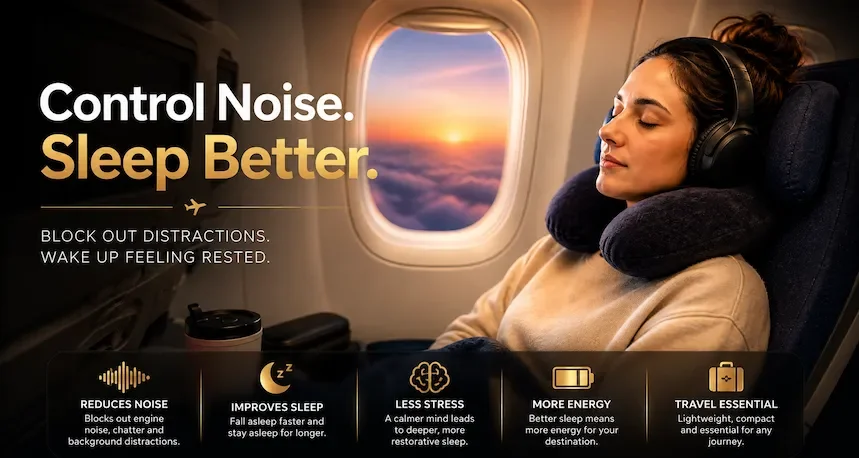
You finally get comfortable, close your eyes…
and just as you start to drift off, something pulls you straight back.
It’s not always the steady background noise of the aircraft.
It’s the changes—
a conversation nearby, movement in the aisle, a call button chime, or something unexpected that breaks your focus.
That’s what makes sleeping on a plane harder than it seems—especially in a noisy cabin where you have little control over your surroundings.
How to Sleep on a Plane, Why Noise Matters More Than You Think
When people think about how to sleep on a plane, they usually focus on comfort.
Seat position, legroom, temperature—those are the obvious ones.
But noise plays just as important a role.
It’s not just about how loud the cabin is—it’s about how stable the environment feels over time.
If the noise around you keeps changing, your brain never fully relaxes.
And that’s what makes it harder to fall asleep—and even harder to stay asleep on a plane.
Where Noise Comes From on a Plane and Why Seat Choice Matters
Noise on a plane isn’t just one thing—it comes from a combination of different sources, and each behaves differently.
Understanding that makes it much easier to manage and reduce noise on a plane.
Aircraft noise (constant)
The most consistent noise comes from the aircraft itself—primarily the engine hum and airflow.
Where you sit makes a difference here.
Seats in front of the wing are generally quieter, while seats over or behind the wing tend to be noticeably louder due to proximity to the engines. - should this para be in this section or the prior previous section?
This type of airplane cabin noise is steady and predictable—but it’s always there in the background.
Cabin and crew noise (intermittent)
Then there’s operational noise within the cabin:
trolley movement in the aisle
crew conversations
call button chimes
movement around the galley and lavatories
If you’re seated near these areas, you may also notice occasional sounds like the aircraft toilet flushing, which can be surprisingly loud if you’re not expecting it.
Passenger noise (unpredictable)
Passenger noise is the least predictable—and often the most noticeable.
Conversations, movement, and other unexpected sounds can interrupt your rest without warning.
It’s one of the few aspects of flying you have no control over—especially once you’re seated.
Why this matters
The challenge isn’t just the volume of these sounds—it’s how they change.
Your brain can adapt to steady background noise, like the hum of the engines.
But sudden or irregular sounds are far more likely to pull you out of sleep just as you start to settle.
By the time most people try to sleep—usually after meal service—it’s not announcements that cause disruption, but these smaller, more frequent changes in the cabin environment.
Why Noise Disrupts Your Sleep
When you’re trying to sleep on a plane, your brain doesn’t fully switch off.
It stays partially alert to your surroundings.
That means even if you don’t fully wake up, changes in noise can:
interrupt your sleep cycle
prevent you from reaching deeper stages of sleep
make your rest feel lighter and less restorative
This is why you can spend hours “sleeping” on a flight but still wake up feeling tired.
It’s not just how long you sleep—it’s how uninterrupted that sleep is.
Why Basic Solutions Don’t Work Properly
On most economy flights, the headphones provided by the airline are simple on-ear designs.
They work for in-flight entertainment—but they don’t block much of the surrounding noise.
Because of that, you often have to turn the volume up just to hear clearly.
At the same time, you’re still hearing the aircraft, the cabin, and the passengers around you.
That combination doesn’t create a stable or relaxing environment—especially if you’re trying to sleep on a noisy plane.
Types of Headphones, Why Design Matters
Not all headphones perform the same—especially on a plane.
There are three main types:
On-ear headphones — sit on top of the ears (commonly provided by airlines, minimal noise isolation)
Over-ear headphones — fully cover the ears (better passive isolation and often stronger noise cancelling)
In-ear headphones (earbuds) — sit inside the ear canal (compact, with good sealing when fitted properly)
Each has its place, but for flying, the key difference is how well they block or reduce external noise.
What Actually Works: Noise-Cancelling Headphones
Noise-cancelling headphones take a different approach.
Rather than just playing sound over the noise, they actively reduce the constant background noise—particularly the low-frequency engine hum.
They don’t eliminate every sound completely.
But they reduce the baseline noise level and soften the impact of sudden sounds.
The result is a more stable, predictable environment—which makes it much easier to sleep better on a plane.
What It Feels Like in Practice
From experience, the difference is immediate.
The moment I put on noise-cancelling headphones, the cabin noise drops into a much lower, softer background level—almost like stepping into your own quiet space.
You’re still aware of your surroundings, but everything feels more distant and controlled.
Some voices and sudden sounds still come through, but at a reduced level.
In the past, I used to play low-volume music as well, which helped mask almost all aircraft noise.
More recently, I’ve found that just the reduced background sound on its own is enough to help me relax and fall asleep.
What I Use Now and Why I Changed
I used to travel with over-ear headphones (Bose QC35 II), which were excellent for reducing airplane noise.
I recently switched to AirPods Pro (2nd generation), which have since been superceded by AirPods Pro (3rd Generation).
The noise cancelling is still very effective, but they take up far less space—and weigh significantly less—which makes a noticeable difference when you’re travelling with a compact setup.
For me, that balance between performance, size, and weight has made them easier to use as part of a consistent in-flight routine.
They’re small enough to keep within easy reach throughout the flight, without adding bulk to my carry-on or seat setup.
That said, no single option is perfect for everyone.
Some people prefer the comfort of over-ear headphones, while others prioritise portability.
Using Bluetooth Headphones with In-Flight Entertainment
One practical limitation when flying is that many in-flight entertainment systems still rely on wired headphone connections.
If you’re using Bluetooth noise-cancelling headphones, that can mean you’re forced back to the airline-provided headphones when watching something.
A simple workaround is to use a small Bluetooth adapter, such as an AirFly bluetooth transmitter by Twelve South.
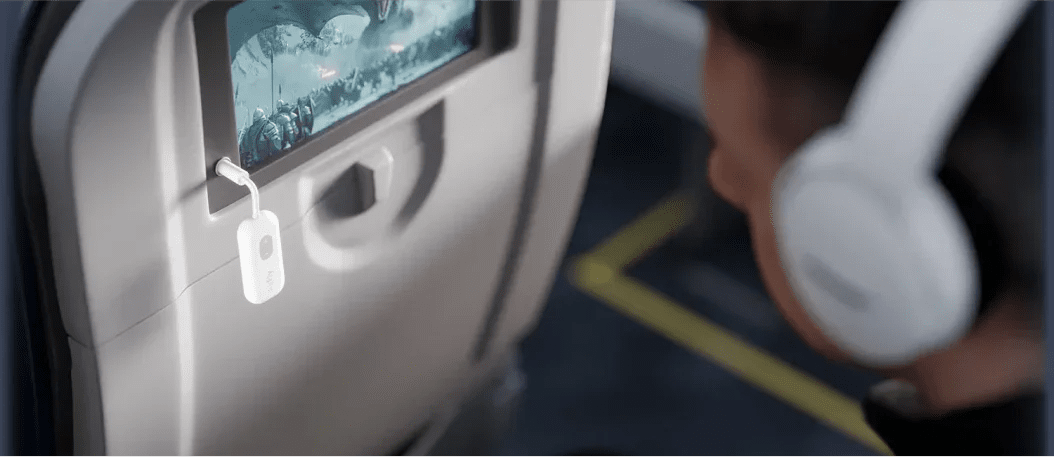
This plugs straight into the aircraft’s headphone jack and allows you to connect your own headphones wirelessly.
It means you can continue using the same noise-cancelling setup—whether you’re watching a film, listening to audio, or just relaxing.
There’s also the added convenience of being able to move around your seat without disconnecting, which makes the overall experience feel much more seamless.
Earplugs: A Simple Alternative for Sleep
Another option worth considering is earplugs.
They don’t actively cancel noise like headphones, but they reduce overall sound levels and can make the environment feel quieter and more consistent.
For sleeping, they can actually be more comfortable—especially on longer flights.
Unlike headphones, there’s nothing resting on your head, and there’s no risk of them shifting or falling off if you move during sleep.
One thing to be aware of is pressure changes during ascent and descent.
Not all earplugs are designed for flying, and some can make pressure changes feel more noticeable.
There are earplugs specifically designed for air travel that help regulate pressure more gradually, which can make a difference on longer flights. A popular brand is “Loop” who currently market the Loop Quiet 2 Ear Plugs.
The trade-off is that earplugs don’t adapt to changes in noise in the same way, and they won’t let important sounds through as easily.
In practice, some people prefer using earplugs for sleep, and headphones when they’re awake or listening to something.
How Controlling Noise Changes Your Seat Options
Seat choice usually comes with trade-offs.
For example, seats closer to the galley or lavatories tend to be noisier, which is why they’re often avoided.
But with effective noise-cancelling headphones, that becomes less of an issue.
In some cases, it can even open up other advantages—such as being able to recline without worrying about disturbing someone behind you, depending on the aircraft layout.
Rather than trying to find the “perfect” seat, controlling noise gives you more flexibility to choose a seat based on comfort, space, or convenience.
How It Fits Into Your Flight Setup
Noise is just one part of the overall picture.
For me, a consistent setup includes:
a supportive travel pillow (for head and upper body stability)
a proper travel blanket (to stay warm and maintain consistent coverage)
a blackout eye mask (to remove light)
staying properly hydrated before and during the flight
a face covering (to keep my face warm, reduce dryness, and add a layer of protection)
choosing the right seat that matches how I naturally sleep
Over time, I’ve found it’s not one item that makes the difference—it’s how everything works together.
One Practical Tip Before You Try to Sleep
One useful feature on many noise-cancelling headphones is transparency mode.
This allows important sounds—like safety announcements—to come through at a reduced level, while still keeping overall noise controlled.
Some newer models also include adaptive transparency, which automatically adjusts how much external sound is let in depending on what’s happening around you, before switching back to noise cancelling mode.
That means louder or sharper sounds are softened, while still allowing you to stay aware when needed.
It’s a simple feature—but it makes a noticeable difference in maintaining comfort without losing awareness.
New Section: Why Noise Matters Even When You’re Not Sleeping
Noise doesn’t just affect sleep—it affects how you feel throughout the entire flight.
Long periods of constant background noise, combined with sudden interruptions, can make it harder to relax.
Over time, that can lead to:
increased fatigue
mental tiredness
a feeling of low-level stress or irritation
Even if you’re not trying to sleep, reducing noise can make the overall experience feel calmer and more manageable.
This is where noise-cancelling headphones are useful beyond sleep—whether you’re watching something, reading, or just trying to switch off.
Final Thoughts: Is Noise Worth Managing?
If you struggle to sleep on a plane, noise is often one of the biggest factors affecting your rest.
It’s not always the loudest sounds that matter—it’s the inconsistency.
By reducing and stabilising the noise around you, you make it much easier for your body to relax and stay asleep.
And combined with a few other simple changes, it can make a noticeable difference to how well you sleep on a plane—and how you feel when you land.
Have you found a good way to deal with noise on flights? Whether it’s headphones, earplugs, or something else, feel free to share your experience in the comments—it may help others as well.
Noise management eventually became one component of a much wider long-haul comfort system designed to reduce fatigue and make travel significantly more manageable overall. Find out more: My Long Haul Travel Setup
Frequently Asked Questions
-
The key is reducing and stabilising the noise around you. Noise-cancelling headphones can lower constant background sounds like engine noise, while earplugs can help reduce overall sound levels. A consistent environment makes it easier to relax and stay asleep.
-
Yes—especially for reducing low-frequency sounds like engine hum. They don’t block every sound completely, but they make the cabin quieter and more stable, which helps you relax and sleep more easily.
-
It depends on preference. Earplugs are often more comfortable for sleeping and won’t move if you change position. Headphones are more versatile and allow you to listen to audio, but some people switch to earplugs once they’re ready to sleep.
-
IThe most effective approach is combining methods. Noise-cancelling headphones reduce background noise, while a good seat choice and a consistent sleep setup can further limit disruptions.
-
Seats in front of the wing are generally quieter, while seats over or behind the wing tend to be louder due to proximity to the engines. However, using noise-cancelling headphones can reduce these differences significantly.
-
Yes, but many in-flight entertainment systems still use wired connections. A Bluetooth adapter (such as AirFly) allows you to connect your wireless headphones and continue using your noise-cancelling setup.
-
Yes. It’s not just the volume of the noise—it’s how it changes. Sudden or inconsistent sounds can interrupt sleep cycles and prevent deeper, more restorative rest.