
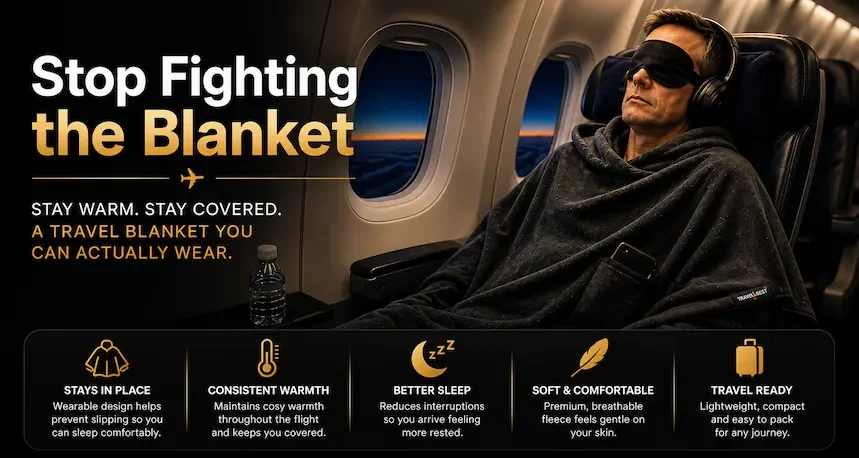
Sleeping on a plane—especially in economy—isn’t easy.
You’re tired, you finally try to sleep… and end up fighting a thin airline blanket that doesn’t stay in place.
You pull it back over your shoulders, settle in again… and a few minutes later, you’re doing the same thing.
It’s a small frustration—but over the course of a flight, it can be enough to stop you getting any meaningful rest at all.
From experience, this is especially noticeable on long-haul flights, where you’re trying to get a few hours of proper rest rather than just a short nap.
It’s not just about comfort—it’s about staying covered consistently.
And that’s something most standard airline blankets don’t do very well.
How to Sleep on a Plane (Why Warmth and Coverage Matter)
When people think about sleeping on a plane, they usually focus on things like seat position, legroom, or noise.
But temperature plays a bigger role than most realise.
It’s not just about being warm—it’s about maintaining a stable, comfortable state long enough to actually fall and stay asleep.
If your body starts to cool down or you lose coverage, you naturally shift position, adjust, or wake up slightly.
Those small interruptions add up.
And over time, they’re often the difference between short, broken naps and proper rest.
Why You Get Cold on Planes (and in Airports)
Aircraft cabins are often cooler than expected, particularly on longer flights.
Air conditioning, airflow from overhead air vents, and changes in altitude can all contribute to a colder environment.
On long-haul flights, blankets are usually provided—but they’re often basic and not always warm enough.
On shorter or connecting flights, blankets may not be available at all.
It’s not uncommon to hear passengers asking cabin crew if any are available once the cabin starts to feel cold.
And beyond the plane itself, airports can be just as uncomfortable.
Air-conditioned terminals, long layovers, or unexpected delays can leave you trying to rest in an environment where you have no control over temperature.
How Being Cold Disrupts Your Sleep
Feeling slightly cold might not seem like a big deal—but when you’re trying to sleep, it has a noticeable effect.
As your body cools, you’re more likely to:
shift position
wake up briefly
struggle to settle into deeper sleep
It’s not always obvious in the moment—but it leads to a pattern of interrupted rest.
And if your blanket isn’t doing its job properly, that problem only gets worse.
Why Airline Blankets Don’t Work Well in Practice
Airline blankets are useful—but they have a few limitations that become obvious once you try to sleep properly.
From experience, the main issues are:
they’re often quite thin and not always warm enough
they don’t stay in place, especially when you move
they don’t provide consistent coverage
Even when they look large enough, small movements can leave parts of your body exposed—creating cold spots that wake you up or stop you settling properly.
And there’s also the practical side.
If you need to get up during the flight, you’ll usually take the blanket off, place it on the seat, and then have to rearrange it again when you sit back down.
It’s a small thing—but it interrupts your flow and makes it harder to get back to sleep.
What Actually Matters in a Travel Blanket
If your goal is better sleep on a plane, a travel blanket needs to do a few key things well:
stay in place, even when you move
provide consistent coverage across your body
keep you warm enough without constant adjustment
Everything else is secondary.
It also helps if it packs down easily and doesn’t take up much space in your bag—especially if you’re travelling with carry-on only.
What I Use Now (and Why It Works)
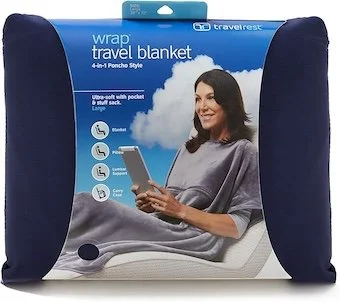
More recently, I’ve switched to the WRAP™ 4-IN-1 Travel Blanket by Travelrest, and it’s become a consistent part of my setup.
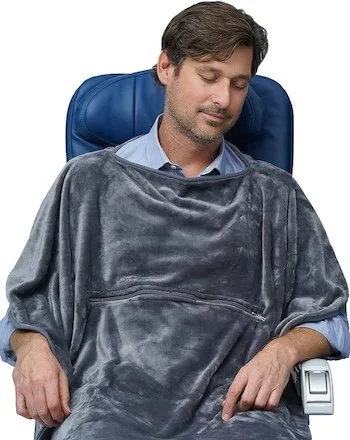
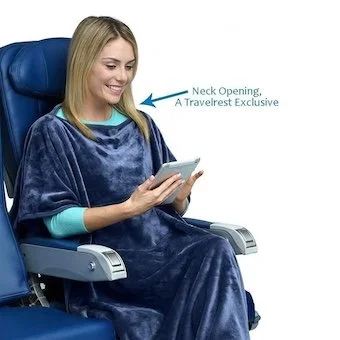
It’s essentially a poncho-style blanket, with a cut-out at the top so you can put it over your head and let it rest across your shoulders.
That simple design makes a big difference.
It stays in place when you’re sitting, when you shift position—and even when you stand up.
On one long-haul flight to Phuket, I tested this properly.
After meal service, I settled in with the blanket, eye mask, and noise-cancelling headphones—and even turned the overhead air vent on full.
My face was cool, but my body stayed completely warm and comfortable.
That consistency made it much easier to stay asleep.
Why the Poncho-Style Design Makes a Difference
One of the biggest advantages is how the blanket behaves in real use.
With a typical airline blanket, you’ll often take it off to let someone out, then sit back down and spend time rearranging it.
With this, it stays on you the whole time.
You stand up, sit back down, and you’re already set.
It’s a small difference—but it means you can settle back into position much faster and get back to sleep more easily.
Coverage and Sizing (Why It Matters More Than You Think)
The Travelrest blanket comes in two lengths—around 60 inches (152 cm) and 72 inches (183 cm).
I use the longer version, which works better for me at 6’2”.
It stays in place over my shoulders when I stand up—but just as importantly, it also covers my legs and feet properly when I’m seated.
With some airline blankets, I’ve often found my feet end up exposed or cold once I shift position.
That’s something I don’t experience with this.
Despite the extra length, it doesn’t get in the way when standing or moving around, which makes it practical to use even in a confined space like an aircraft cabin.
Practical Features That Make It Easier to Use
Beyond the core design, a few practical features make it more convenient:
a built-in zippered pocket large enough for items like glasses, headphones, or a phone—so they don’t get lost during the flight
the ability to fold into itself, doubling as a small pillow
a separate stuff sack for easier storage in a cabin bag
a strap for attaching it to luggage
It’s also relatively lightweight at around 14 oz (about 378 grams), so it doesn’t add much bulk to your setup.
Where a Travel Blanket Comes in Useful
Although I mainly use this for flying, it’s one of those items that ends up being useful in more situations than you expect.
Any time you don’t have full control over temperature, it helps.
For example:
Airports — especially during long layovers or delays
Trains — where temperature can vary
Cars (as a passenger) — for longer journeys
Hotel rooms — particularly when air conditioning runs cold
Even cold offices — where you’re sitting still for long periods
It’s not just a “flight item”—it’s something you’ll likely end up using more often than you think.
How It Fits Into Your Flight Setup
A travel blanket on its own won’t solve everything.
But combined with the right setup, it can make a big difference.
For me, that includes:
a supportive travel pillow (for head and upper body stability)
noise-cancelling headphones (to reduce background noise)
a blackout eye mask (to remove light)
staying properly hydrated before and during the flight
a face covering (to keep my face warm, reduce dryness, and add a layer of protection)
choosing the right seat that matches how I naturally sleep
Over time, I’ve found it’s not one item that makes the difference—it’s how everything works together.
One Practical Tip Before You Fall Asleep
One thing worth keeping in mind:
If you’re properly settled and covered, you’ll be less aware of what’s happening around you.
That’s generally a good thing—but it also means it’s worth making sure everything is secure before you settle in.
keep valuables like your passport and wallet safely stored
make sure any luggage is properly closed or secured
Once that’s sorted, it’s much easier to relax and switch off properly.
Final Thoughts: Is a Travel Blanket Worth It?
If you struggle to sleep on flights, staying warm and properly covered is one of the simplest changes you can make.
It doesn’t require a complicated routine—just the right setup.
A well-designed travel blanket removes one of the most common causes of sleep disruption: losing coverage and getting cold.
And combined with a few other small changes, it can turn broken, inconsistent rest into something much more reliable.
If you’ve found ways to stay comfortable on flights—or had similar experiences—I’d be interested to hear.
Frequently Asked Questions
-
Not always—but it can make a big difference.
Planes are often cooler than expected, especially on long-haul flights. A blanket helps maintain warmth and comfort, which makes it easier to stay asleep for longer.
-
Airline blankets can help, but they’re often thin and don’t stay in place very well.
This can lead to frequent adjustments, cold spots, and interrupted sleep—especially if you move during the flight.
-
Cabin air conditioning, airflow from overhead vents, and long periods of sitting still can all cause your body temperature to drop.
This is particularly noticeable on longer flights or in air-conditioned airports.
-
A good travel blanket should:
stay in place
provide consistent coverage
keep you warm without constant adjustment
Practical features like compact storage and portability also help.
-
A poncho-style travel blanket has a cut-out section that allows you to wear it over your shoulders.
This helps it stay in place while you sit, move, or stand—reducing the need to constantly readjust it.
-
Yes—travel blankets are useful anywhere you don’t have control over temperature.
This includes airports, trains, cars, hotel rooms, and even cold office environments.